
Segment, COG and Character LCD Modules for Instruments and Meters
Instruments show the same few numbers for years, often on battery. That makes the expensive colour panel the wrong answer: a custom segment glass or a monochrome COG module draws a fraction of the current, stays readable in daylight without a backlight, and costs less per unit. We build custom TN, HTN and VATN segment glass, COG graphic modules from 128x64 to 240x128, and character modules from 8x2 to 20x4.
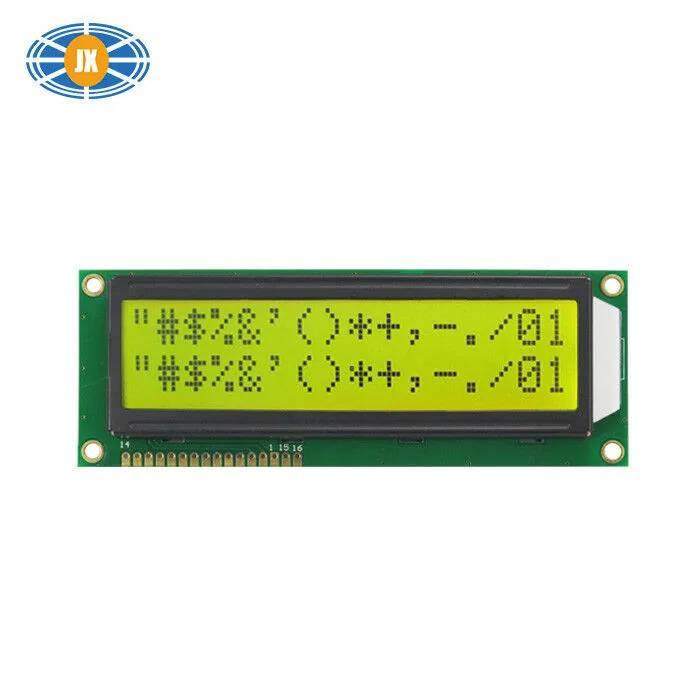
Model, size and rating figures on this page are read directly from the specifications of our published models - the same numbers appear on each product page. Of the 188 models in our current production list, 26 are tagged internally for this application; the 38 below are the ones with a full English specification published so far.
What this application actually demands
| Requirement | Why it decides the design | What we build |
|---|---|---|
| Power draw | A meter on a lithium primary cell cannot afford a colour TFT backlight. | Reflective and transflective segment / COG glass runs without a backlight; backlight only when the operator needs night reading |
| Readability | Meters are read in daylight and at odd angles. | Transflective and positive-mode options; VATN for high contrast black-on-clear |
| Custom glass | Fixed readouts (units, symbols, bar graphs) belong in the glass, not in software. | Custom TN, HTN and VATN segment layouts; tooling MOQ 1,000 pcs |
| Interface | Most meter MCUs have no display controller and few free pins. | 6800/8080 parallel, SPI, I²C on COG and character modules |
| Operating temperature | Utility and field meters sit outdoors. | -20 °C to +70 °C standard, wider on selected parts |
Models that fit
Selection rule: all segment, COG graphic and character modules, plus OLED modules under 3.5". Nothing else is filtered - if a published model meets that rule it is in this table, and you can check it against the specification on the product page. Values are typical at 25 °C.
| Model | Size | Resolution | Interface | Brightness | Touch | Operating temp |
|---|---|---|---|---|---|---|
| JM320240A | 5.7" | 320×240 | - | High Brightness | - | -20°C to +70°C |
| JM240128C | 5.2" | 240×128 | Emulator | 200 cd/m² | Without Touch Screen (Customizable) | -20°C to +70°C |
| JM240128C09-GSBLWNG5 | 5.0" | 240×128 | 8080-8bit | 200 cd/m² | - | -20°C to +70°C |
| JM19264C | 4.3" | 192×64 | - | 200 cd/m² | Customizable | -20°C to +70°C |
| JM12864G | 3.8" | 128×64 | - | 220 cd/m² | Customizable | -20°C to +70°C |
| JM-2004C-00 | 3.2" | 20×4 | - | 100 cd/m² | - | -20°C to +70°C |
| JM-PL051-LG12864 | 3.2" | 128×64 | 6800/8080/4-LINE | 150 cd/m² | - | -20°C to +70°C |
| JM-L12806404 | 3" | 128×64 | Parallel/Serial | 150 cd/m² | - | -20°C to +70°C |
| JM-PL054-00 | 3" | 160×160 | 4bit SPI | 150 cd/m² | - | -40°C to +70°C |
| JM12864C08 | 3" | 128×64 | Serial/Parallel Port,SPI | 150 cd/m² | Without Touch Screen (Customizable) | -20°C to +70°C |
| JM240128C07 | 2.9" | 240×128 | Parallel/Serial | 200 cd/m² | - | -20°C to +70°C |
| JM240160C02 | 2.9" | 240×160 | SPI | 150 cd/m² | - | -20°C to +70°C |
| JM16096C02 | 2.5" | 160×96 | SPI4 | 150 cd/m² | - | -20°C to +70°C |
| JM-P0159-00 | 2.42" | 128×64 | 6800/8080 INTERFACE | 120 cd/m² | Without Touch Screen (Customizable) | -40°C to +70°C |
| JM-PT095-02 | 2.4" | 240×320 | 8-bit Parallel Interface (8080 MPU) | - | - | on request |
| JM-PL042-LG19264 | 2" | 192×64 | STN | 150 cd/m² | - | -20°C to +70°C |
| JM19264C03 | 2" | 192×64 | Parallel/Serial | 150 cd/m² | - | -20°C to +70°C |
| JM-PO139-01 | 1.54" | 128×64 | 6800/8080 Parallel, 4-wire SPI | - | - | -40°C to +85°C |
| JM-PO150 | 1.54" | 128×64 | I 2C | - | - | -40°C to +70°C |
| JM-PL024 | 1.5" | 128×32 | 4-line SPI | 200 cd/m² | - | -20°C to +70°C |
| JM-PO128 | 1.46" | 128×128 | 8-bit For Parallel | - | - | -40°C to +70°C |
| JM-PO139-01 | 1.3" | 128×64 | 4-wire Serial Interface | - | - | -40°C to +70°C |
| JM-PO158-01 | 1.3" | 128×64 | 8-bit 68XX/80XX Parallel, 3/4-wire SPI | - | - | -40°C to +70°C |
| JMP0121 | 1.3" | 128×64 | 6800/8080 INTERFACE | 120 cd/m² | selectable | -40°C to +70°C |
| JM-PO122-00 | 0.96" | 128×64 | 6800/8080 Interface, I2C | - | - | -40°C to +70°C |
| JM-PO136 | 0.96" | 128×64 | IIC | - | - | -40°C to +70°C |
| JM-PO107 | 0.49" | 64×32 | Parallel/Serial | - | - | -40°C to +70°C |
| JM-1602-06 | " | - | SPI Serial Port | 150 cd/m² | - | on request |
| JM-L12806405SGNSL-A0 | " | 128×64 | Parallel/Serial | 150 cd/m² | - | -20°C to +70°C |
| JM0802B | " | 8×2 | Emulator | 100 cd/m² | - | -20°C to +70°C |
| JM12232B | " | 122×32 | - | 190 cd/m² | Without Touch Screen (Customizable) | -20°C to +70°C |
| JM1602A | " | 16×2 | - | 100 cd/m² | - | -20°C to +70°C |
| JM1602M | " | 16×2 | - | 100 cd/m² | - | -20°C to +70°C |
| JM19264C02 | " | 192×64 | Parallel/Serial | 200 cd/m² | - | -20°C to +70°C |
| JM2002A | " | 20×2 | - | 100 cd/m² | - | -20°C to +70°C |
| JM2004A | " | 20×4 | - | 100 cd/m² | Without Touch Screen (Customizable) | -20°C to +70°C |
| JM240128J-1 | " | 240×128 | - | 500 cd/m² | - | -20°C to +70°C |
| JM24064A | " | 240×64 | - | 200 cd/m² | Customizable | -20°C to +70°C |
Not seeing the combination you need? 188 models are in production and roughly 120 new ones are developed each year, so ask before assuming it does not exist.
Three things that go wrong
Written from the enquiries we have to correct most often.
Using a graphic module where a segment glass belongs
If the display always shows the same fields, a custom segment glass is cheaper per unit, draws less current and needs almost no firmware. The trade is tooling: segment glass needs a mask and 1,000 pcs to be economic. Below that, a COG graphic module is the right compromise.
Forgetting the viewing direction at design time
Segment and STN glass has a preferred viewing angle - 6 o'clock and 12 o'clock builds are physically different parts. A panel-mounted meter read from above and a handheld read from below need opposite choices, and this is fixed in the glass, not in firmware.
Specifying a backlight you do not need
The backlight is usually the largest single load in a battery meter. Reflective glass needs none in daylight; a switched backlight for occasional night reading costs far less energy than a permanently lit transmissive panel.
What we can change - and what we cannot
Changed on a catalogue panel
FPC length, pin order and exit direction; connector type; backlight brightness and colour; touch panel and cover glass; driver IC selection within what the glass supports; PCBA and firmware on smart serial modules. These start at 100 pcs and do not need new glass tooling.
Needs new tooling
A new glass size or shape, a custom segment layout, a new touch sensor pattern. Tooling MOQ is 1,000 pcs and we quote the tooling cost separately so you can see what is one-off and what is per-piece.
What we will not claim
We do not quote a panel we cannot build to your temperature, brightness and lifetime figures at the same time. If one of the three has to give, we say which one before you order samples rather than after.
Commercial terms
Sample 5 pcs in 10-15 days; production 100 pcs in 10-20 days. EXW, FOB Shenzhen, CIF. T/T, L/C, PayPal. Packed as anti-static bag + foam tray + export carton.
Product categories used in this application
Segment LCD Displays
Fully custom TN, HTN and VATN segment glass for meters, appliances and instruments.
0 modelsGraphic LCD Modules
Monochrome dot-matrix graphic modules - 128x64, 192x64, 240x128 - COG and COB, FSTN and STN, low power.
21 modelsCharacter LCD Modules
Alphanumeric modules 8x2 to 20x4 with 6800, I2C and SPI interfaces and multi-colour backlight.
7 modelsInstrumentation & Metering displays - questions
Can you make a custom segment LCD for our meter?
Yes - custom TN, HTN and VATN segment glass is one of our core lines. You send the layout (or a photo of the current display and a sketch), we return a drawing for approval, then tooling. Custom glass MOQ is 1,000 pcs; tooling cost and sample timing are quoted per layout.
What is the difference between TN, HTN and VATN?
TN is the cheapest and lowest contrast. HTN improves contrast and viewing angle at a small premium. VATN gives near-black background with bright characters and the widest viewing angle, and is what most modern instrument fronts use. The choice mostly follows how premium the front panel needs to look.
Do you have displays that work without a backlight?
Yes. Reflective and transflective segment and COG glass is readable in ambient light with no backlight at all, which is what makes multi-year battery life possible. Transflective parts add a backlight for dark conditions without losing daylight readability.
Which interface do your monochrome modules use?
6800/8080 parallel, SPI (including 4-wire SPI) and I²C, depending on the model. The interface of every published model is listed in the table on this page - pick the one your MCU already has free pins for.
What are the MOQ and lead time?
Catalogue COG and character modules start at 100 pcs with 10-20 days lead time. Custom segment glass needs tooling and 1,000 pcs. Samples of catalogue parts are 5 pcs.
Need a quote or a datasheet?
Send us size, resolution, interface and annual quantity. Our engineers reply within one working day. Sample MOQ 5 pcs, lead time 10-20 days.