
How Many Nits Does a Sunlight-Readable Display Need?
Short answer: 200-300 cd/m² indoors, 350-450 cd/m² for shaded outdoor or a window-lit factory, and 500 cd/m² or more - or a transflective build - for direct sun. But raw brightness is only half of it. What the eye reads is contrast against reflected ambient light, so an anti-glare surface or a transflective polariser can beat a brighter panel that mirrors the sky back at you.
Written by the Junxian applications engineering team. Figures quoted for “our models” are calculated from the 103 models on this site that carry a full parameter set, so they change when the catalogue changes.
What do nits and cd/m² mean on a datasheet?
They are the same unit: one nit equals one candela per square metre. On a display datasheet the figure is surface luminance at full backlight drive, typically at 25 °C and measured at the centre of the panel. Two things it does not tell you: what happens at the panel edges, and what happens once you dim the backlight to protect battery life or thermal budget, which in a real product you almost always do.
Brightness bands and what each is for
Published models on this site span 100 to 600 cd/m². Here is what each band is actually for.
| Brightness band | Models | Sizes available | Where it belongs |
|---|---|---|---|
| Under 150 cd/m² | 8 | 1.3" - 3.2" | Indoor instruments, reflective and transflective glass |
| 150 - 249 cd/m² | 24 | 1.5" - 5.2" | Indoor panels, enclosed equipment |
| 250 - 349 cd/m² | 27 | 1.14" - 15.6" | Bright indoor, shop floor, shaded outdoor |
| 350 - 449 cd/m² | 16 | 0.96" - 10.1" | Window light, canopy-covered outdoor |
| 450 cd/m² and above | 17 | 2.8" - 10.1" | Direct daylight, outdoor posts and kiosks |
Surface luminance as specified for each published model, measured at full backlight drive and 25 °C.
Why brightness alone does not make a display readable
Sunlight readability is a contrast problem. In direct sun the surface can reflect several thousand cd/m² back at the viewer; a 500 cd/m² backlight cannot out-shout that, so what you actually change is the reflection: anti-glare or anti-reflective treatment, optical bonding to remove the air gap between touch panel and glass, and transflective glass that uses the sunlight itself instead of fighting it. Optical bonding alone often does more for outdoor readability than a step up in nits, and it costs less power.
What high brightness costs you
Three things, all of which matter in a sealed enclosure. Power: the backlight is usually the largest single load. Heat: that power becomes heat inside a housing that may already be warm, and LED lifetime falls as junction temperature rises. Lifetime: published backlight life of around 40,000 hours is quoted at rated drive - running below full drive extends it substantially. Which is why the honest answer to 'how bright should it be' is 'as bright as it needs to be at the dimmest setting you can live with', not 'as bright as available'.
Dimming, PWM and what the user actually sees
Almost every product runs its backlight below full drive most of the time, so how you dim matters as much as the peak figure. PWM dimming switches the LED string on and off faster than the eye can follow and keeps colour consistent across the range, which is why it is the usual choice; the frequency has to be high enough that a camera pointed at the screen does not band, which matters more than it used to now that customers photograph equipment for support tickets. Analogue dimming reduces current instead and can shift colour slightly at the bottom of the range. Two practical consequences: specify the dimming range you need, because the driver has to support it; and remember that perceived brightness is not linear with duty cycle, so a UI slider that maps 0-100 % linearly will feel wrong at the dark end and should be curved.
How to specify brightness so the quote is right first time
Tell us three things instead of a nit figure: where the display is (indoor cabinet, shop floor near windows, outdoor under a canopy, direct sun), whether it is battery powered, and whether the enclosure is sealed. Those decide brightness, surface treatment and bonding together - which is how the decision is actually made.
Pick your environment, get a number
A quick version of the same decision - not a substitute for telling us the full context above.
Wide temperature and brightness usually arrive together
Equipment that lives outdoors needs both. Our cold-rated models are listed here so you can see which end of the range is available before designing around it.
| Coldest rated operating temperature | Models on this site |
|---|---|
| -40 °C | 11 |
| -20 °C | 74 |
| -10 °C | 12 |
Storage ranges run wider: typically -30 °C to +80 °C on standard parts and -40 °C to +85 °C on wide-temperature parts.
Troubleshooting: the display seems dimmer than the datasheet says
Before assuming the panel is faulty, check the backlight drive itself. The most common cause is simply underdriven current: a resistor-limited backlight circuit that was sized for a different LED string, or a PWM dimming duty cycle left low from debugging, produces a display that looks correctly initialised but visibly dim. Check actual current at the LED string with a meter, not the value in your firmware - a current-limiting resistor calculated for the wrong forward voltage is a common design error, not a component fault. Second cause: PWM frequency set too low, which some eyes and most cameras perceive as reduced brightness even though average current is correct - raise it above roughly 200 Hz and the effect disappears. Third: thermal derating, where a backlight driver reduces current automatically once it senses a temperature above its rated point - if the display dims only after running for a while in a warm enclosure, this is almost always the cause, and the fix is thermal, not electrical.
Our brightest published models (400 cd/m² and above)
Published models that illustrate the point above - full specifications on each page.
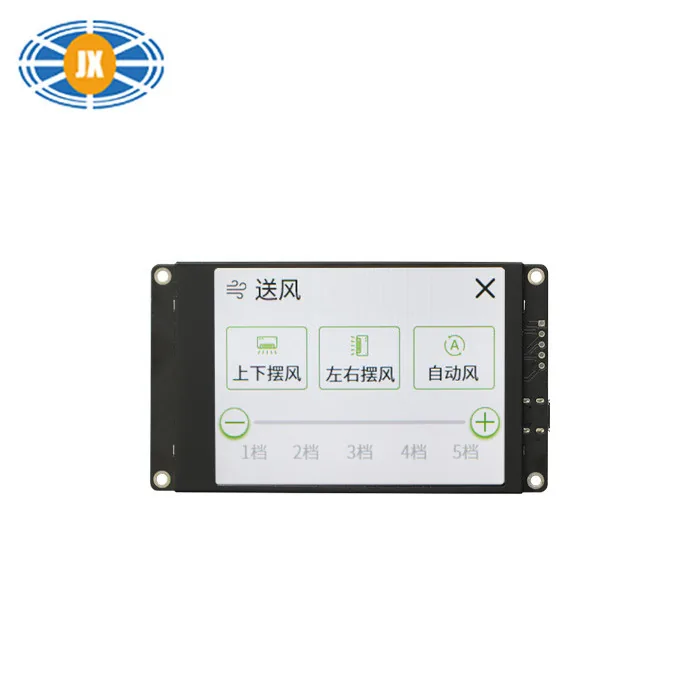
3.5 Inch IPS Display Industrial Serial Port LCD Display Touchscreen LC
JM-LH011-TI320240NUL035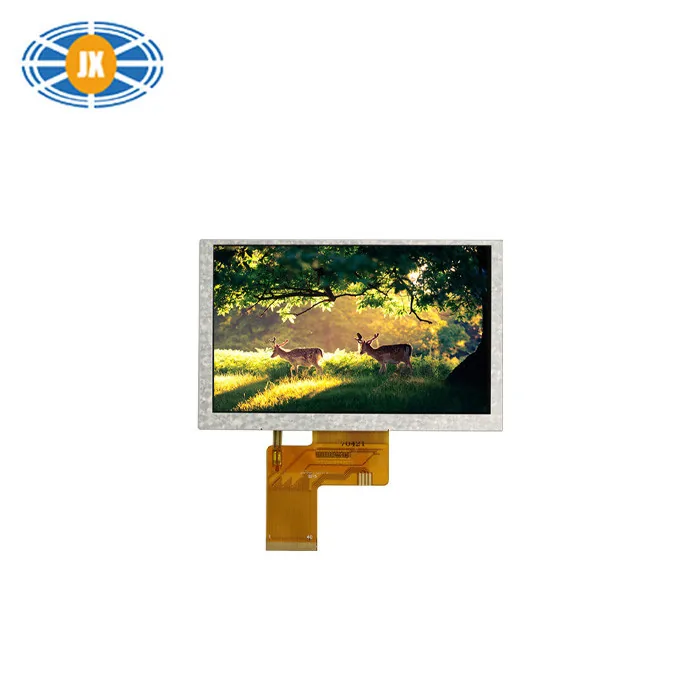
Touchscreen LCD Monitor 5 Inch TFT Color LCD Display 800×480 Resolutio
JM-PT069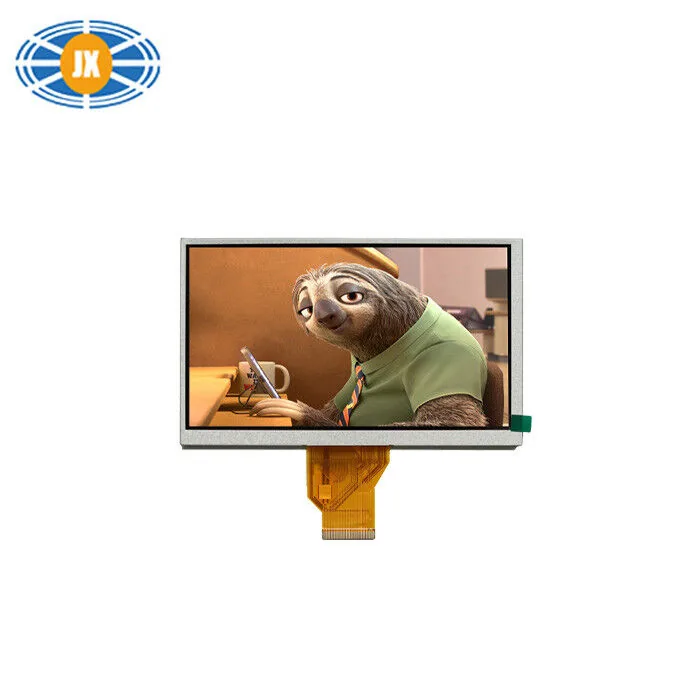
7 Inch TFT LCD Screen 500cd/m2 High Luminance Color TFT Touch Screen
JM-PT042-TT800480CRL070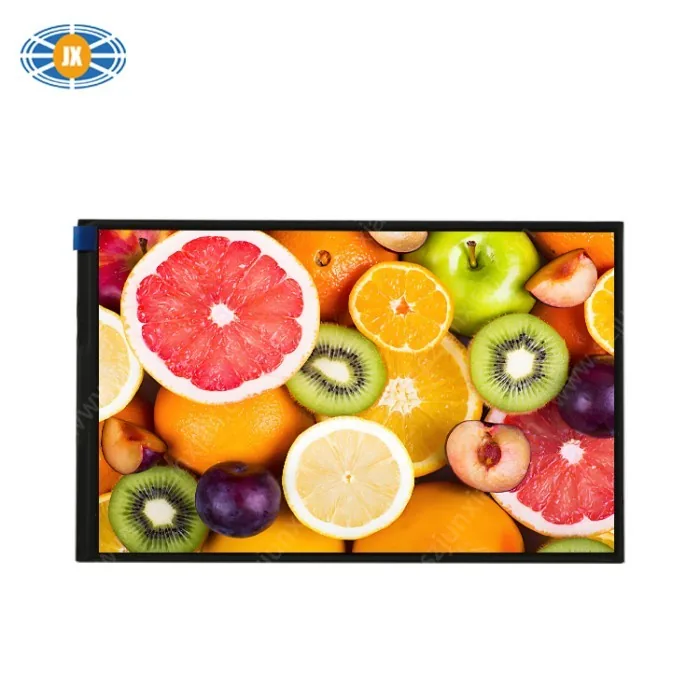
10.1 inch Color TFT LCD Display MIPI Interface High Luminance LCD Moni
JM-PT134-01Related guides
Transmissive, Reflective or Transflective LCD: Which Do You Need?
An LCD makes no light of its own - it controls light that comes from somewhere else. Where that light comes from is decided by the...
Capacitive or Resistive Touch, Air Bonding or Optical Bonding
Capacitive touch wins on feel, multi-touch and durability, and it is what most buyers now specify by default. Resistive still beat...
LCD Interfaces Explained: SPI, MCU, RGB, LVDS and MIPI
The interface is the first decision, not the last: it decides whether your processor can drive the panel at all, how many pins the...
Questions engineers ask us about this
How many nits is enough for direct sunlight?
500 cd/m² is the practical floor for a transmissive panel in direct sun, and even then surface treatment and optical bonding do much of the work. Where the display faces the sun all day, a transflective build is more effective and uses less power than pushing the backlight higher.
Is 300 cd/m² bright enough for a factory floor?
Usually yes for interior lighting, and marginal next to a large window. If the panel sits within a few metres of daylight, specify 350-450 cd/m² with an anti-glare surface - the extra cost is small compared with an unreadable HMI.
Does higher brightness shorten the backlight life?
Running at full drive gets you the quoted figure - about 40,000 hours to half brightness on published parts. Higher drive current and higher ambient temperature both shorten it, and dimming extends it. Design the UI so the backlight can be dimmed when nobody is looking at it.
What is optical bonding and do I need it?
Filling the air gap between the touch panel and the display with optical adhesive. It removes an internal reflection, so contrast in bright light improves noticeably, and it makes the stack stronger. It costs more and is harder to rework, so it is worth it outdoors and for handhelds, less so for an enclosed indoor panel.
Can you make a transflective display in my size?
Ask with the size and resolution. Transflective is standard on monochrome segment and COG glass and available on selected colour panels - it is a glass-level choice, not something that can be added to a finished module.
Need a quote or a datasheet?
Send us size, resolution, interface and annual quantity. Our engineers reply within one working day. Sample MOQ 5 pcs, lead time 10-20 days.