
Industrial OLED Lifetime, Burn-In and How to Design Around It
OLED gives up backlight lifetime for contrast, power efficiency at low brightness and a thinner module than any backlit panel on this site. Whether that trade is worth it depends less on the datasheet number than on what the UI actually shows, which is the part most buyers skip past.
Written by the Junxian applications engineering team. Figures quoted for “our models” are calculated from the 103 models on this site that carry a full parameter set, so they change when the catalogue changes.
What an OLED lifetime rating actually means
Every organic pixel dims with use - there is no backlight to fail, the emissive material itself loses brightness. A published lifetime figure is normally the number of hours of continuous operation at a stated brightness and temperature before output falls to half its initial value. It is a decay curve, not a failure point: the display does not stop working at that hour count, it has simply dimmed by 50% from where it started, and different colours on the same panel age at different rates because they use different organic materials.
Why burn-in happens
Burn-in is uneven ageing, not a defect - a pixel that stays lit at high brightness for most of its life dims faster than one that is rarely lit or spends most of its time on darker content. Static elements - a logo, a fixed border, a battery icon in the same corner on every screen - are the classic cause, because those specific pixels accumulate far more "on" time than the pixels around them, and the difference eventually becomes visible as a faint ghost image.
Design techniques that extend real service life
- Avoid static full-brightness elements. A logo or icon that never moves is the single biggest cause of visible burn-in; if the UI needs one, keep it dim rather than at full white.
- Pixel-shift where the UI allows it. Nudging static content by a pixel or two on a timer spreads the wear across more pixels - simple to implement in firmware, and standard practice on OLED products that run continuously.
- Dim or blank the display when it is not being read. Every hour not spent at full brightness is an hour not spent on the decay curve - a screen saver or auto-dim after inactivity is a lifetime decision, not just a power one.
- Favour darker backgrounds. Because OLED pixels are only powered when lit, a dark UI with bright accents both draws less power and ages more evenly than a bright background with dark text.
When OLED is the right call, and when it is not
OLED wins on contrast (true black, since unlit pixels draw no power at all), on power at low average brightness, and on module thickness - relevant for wearables and compact instrument faces. It loses on peak brightness and on service life under a static, always-on UI compared with a transmissive TFT with a conventional LED backlight, whose lifetime is defined the same way but tends to degrade more evenly across the panel. If the product runs continuously with a mostly static display, specify carefully or consider TFT; if the UI is naturally dynamic, low average brightness, or brief-use, OLED is usually the better fit.
OLED modules currently in production
Published models that illustrate the point above - full specifications on each page.
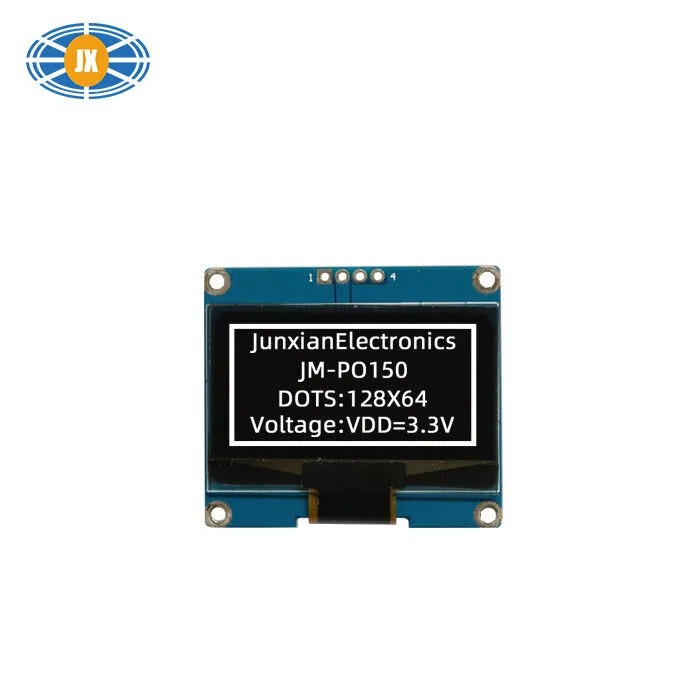
Monochrome Dot Matrix 1.54 Inch OLED Display 128x64 Pixels I2C Interfa
JM-PO150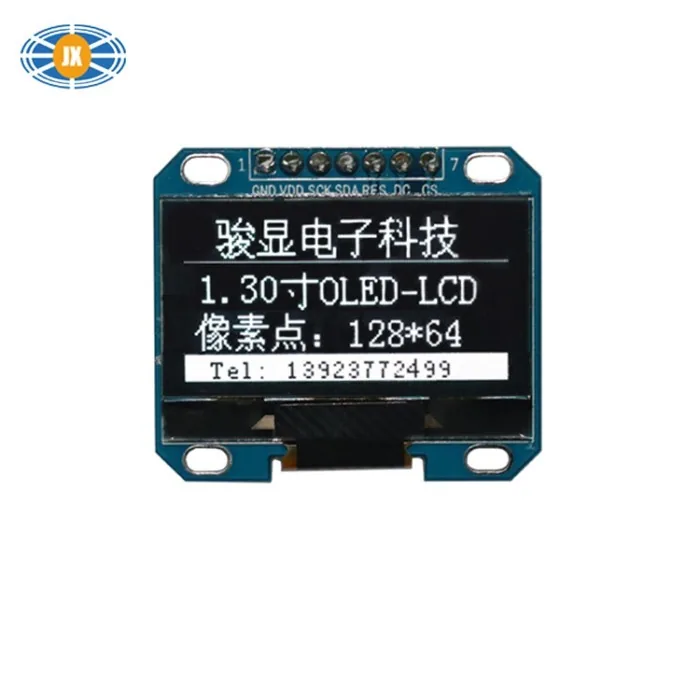
1.3 Inch OLED Display Module 128x64 160° Viewing Angle Lcd Monitor Wit
JM-PO139-01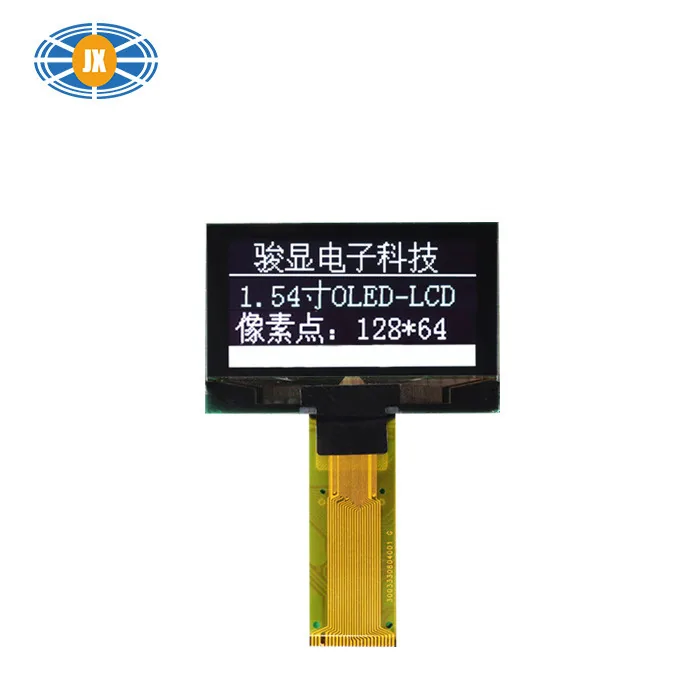
Compact 1.54 Inch OLED Display Module Power Efficiency LCD Monitor Wit
JM-PO139-01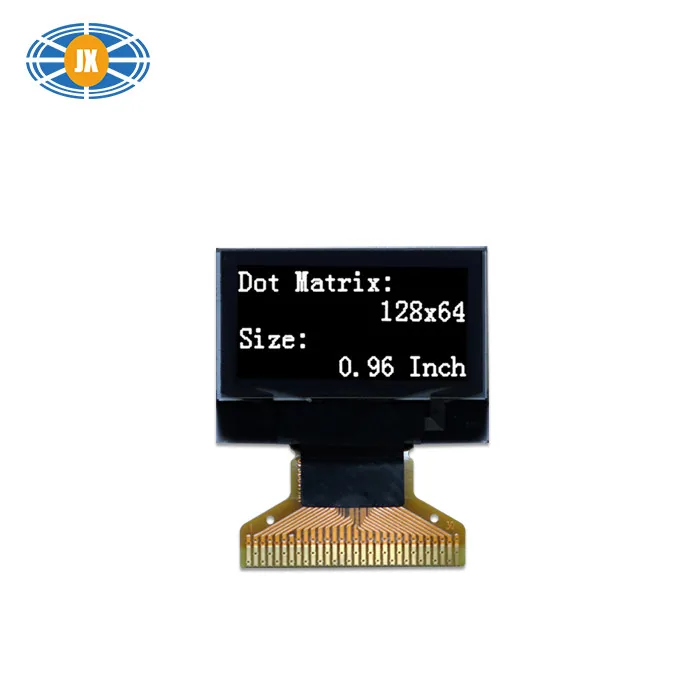
0.96 Inch OLED Display Module 128x64 White Monochrome LCD Monitor For
JM-PO122-00Related guides
LCD Image Sticking, Pressure Marks and Mura: Causes and Prevention
Three complaints reach display suppliers more than any others once a product is in the field: a faint ghost of an old screen that ...
TN, IPS, VA and STN: Which Glass Mode Should You Specify?
Glass mode decides how the display looks from where the operator actually stands. IPS holds colour and contrast off-axis and is th...
How Many Nits Does a Sunlight-Readable Display Need?
Short answer: 200-300 cd/m² indoors, 350-450 cd/m² for shaded outdoor or a window-lit factory, and 500 cd/m² or more - or a transf...
Questions engineers ask us about this
How long do your OLED modules actually last?
Lifetime depends on brightness setting, ambient temperature and how static the displayed content is, so a single number without those conditions is not meaningful. Tell us your duty cycle and typical UI and we will give a figure for your actual use case rather than a worst- or best-case datasheet number.
Can burn-in be fixed once it happens?
Not reliably - it is a form of physical wear, not a software fault. Pixel-shift and dimming are prevention, not a cure once ghosting is visible.
Is monochrome OLED affected by burn-in the same way as colour OLED?
The mechanism is the same - uneven pixel ageing from uneven use - but monochrome panels typically run a single, more uniform material, so colour-specific ageing differences do not apply the way they do on a colour OLED.
Should I choose OLED or TFT for an always-on industrial display?
If the UI is mostly static and the display runs continuously, a TFT with a conventional backlight usually gives more predictable long-term appearance. OLED is the better choice when the UI is naturally dynamic or the display is not on continuously.
Need a quote or a datasheet?
Send us size, resolution, interface and annual quantity. Our engineers reply within one working day. Sample MOQ 5 pcs, lead time 10-20 days.